High-altitude drone production
Immersive high-mountain drone production at 3.800m
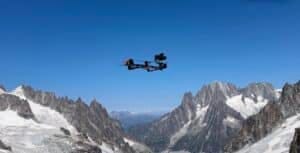
Some film productions are just different. This one started with a phone call asking whether we could fly the Blackmagic URSA Cine Immersive on one of Europe’s largest glaciers, at nearly 4,000 metres above sea level, for multiple days in a row while camping in a self-built base camp on the ice.
High-mountain film production
The assignment came in a few months before the shoot. The client was looking for a partner capable of flying the Blackmagic URSA Cine Immersive camera at altitudes between 3,500 and 4,000 metres in the French Alps. Kiwi Aerial Shots is one of the very few, if not the only drone company in the world capable of flying this camera in a stabilised setup while offering a completely unobstructed 180-degree field of view. Our custom-built Immersive Condor positions the camera ahead of all propellers, meaning no rotors or drone parts ever enter the frame and nothing needs to be removed in post. On top of that, the immersive spatial footage is completely vibration-free and ready to use in the edit straight out of the camera.
The challenge for us lay in the high-altitude drone cinematography itself. We are a Netherlands-based company and the Immersive Condor had primarily been flown at sea level. Our highest previous immersive shoot was at around 400 metres above sea level, near Evian-les-Bains for a production at the Evian Golf Championship on Lake Geneva. Filming at 3,800 metres was going to be a very different story.
The Physics of High-Altitude Drone Flight
At high altitude, air density drops significantly. With less dense air to generate thrust against, the motors have to work harder to produce the same lift, either by spinning faster or by using high-altitude propellers with a greater pitch or diameter to move more air per revolution. Thinner air also reduces the aerodynamic authority of the drone, making it slower and less predictable in its response to control inputs. For the pilot, this means less margin, tighter concentration, and considerably more workload on every single flight.
To tackle this, we sourced several types of high-altitude propellers, including lightweight carbon props from Fluxer and various options with increased pitch and diameters ranging from 28 to 30 inches and beyond. A few days before the shoot, we headed up to 3,800 metres with the client and an extra porter for a full afternoon of test flights on the glacier. The goal was twofold: acclimatisation for the team and a thorough test of the drone across different propeller configurations, comparing thrust, stability and handling. By the end of the session, we had found the optimal setup for high-altitude drone cinematography with the Immersive Condor.
Rather than carrying the drone, all 11 kilograms of it, back down the mountain, we made a pragmatic call: we hid it between the rocks, tightly wrapped in plastic to protect against rain and snow. It was not an easy decision. Would it go unnoticed? What if it snowed heavily or the wind picked up? Our producer convinced us it would be fine, any alpinist stumbling across a heavy-lift cinema drone in the middle of a glacier would almost certainly leave it alone. And he was right. When we returned, the drone was exactly where we left it, completely intact.


Preparation and days on the Glacier
Preparing for the production days went far beyond getting the drone ready. We would be spending several days on the glacier in a tented basecamp, which meant carefully planning not just the camera equipment but also food, accommodation, clothing and all the alpine gear. Our total kit, equipment, tents, food, ropes and everything else, weighed around 100 kilograms, making porters an absolute necessity alongside the film crew. The logistics of this production were those of a serious mountain expedition, because that is essentially what it was.
Spending extended time on a glacier is a different experience altogether. Your heart rate runs higher than usual, sleep is harder to come by, the shade brings a biting cold, and every meal and drink starts as a pan of melted snow. Charging batteries adds another layer of complexity. A generator was out of the question, so we brought multiple EcoFlow solar panels connected in parallel to two EcoFlow power stations. Slower than we are used to, but just enough to keep the batteries topped up between flights.
Due to production circumstances we are unable to go into detail about, we were unable to film at the originally planned location next to basecamp. This meant a daily glacier crossing of an hour and a half each way to reach the shoot location, moving in rope teams with a mountain guide, each of us carrying a backpack of over 30 kilograms loaded with batteries, the Blackmagic URSA Cine Immersive camera, a Movi gimbal and all supporting equipment. Through the snow, on crampons, jumping over crevasses dropping tens of metres into the ice below. There and back every single day. Demanding, without question. But also extraordinary, surrounded by the peaks of the Mont Blanc massif with a motivated crew and exceptional mountain guides.
Results
The Immersive Condor performed brilliantly at 4,000 metres. Every shot came out vibration-free, nothing needed to be removed in post and all footage was ready to use in the edit straight out of the camera. Exactly what a professional immersive film production demands. We captured both sweeping wide establishing shots and detailed close-ups of some of the most spectacular alpine landscapes on the second largest glacier in Europe.
On the final night we were given shelter in the old, no longer used section of a mountain hut, a welcome roof over our heads after days on the glacier. A real bed, a hot meal without melted snow, and decent coffee. The following morning we descended to the valley for the last shots of the production and closed it all out with a well-earned BBQ.
EMBARGO
Due to a full embargo on this production, we are unable to share details about the client, the production company or the subject of the film at this stage. Once everything goes live, we will update this article with the full story, behind-the-scenes footage and, where possible, some of the immersive aerial shots themselves. Stay tuned.
MONT-BLANC DRONE PRODUCTION
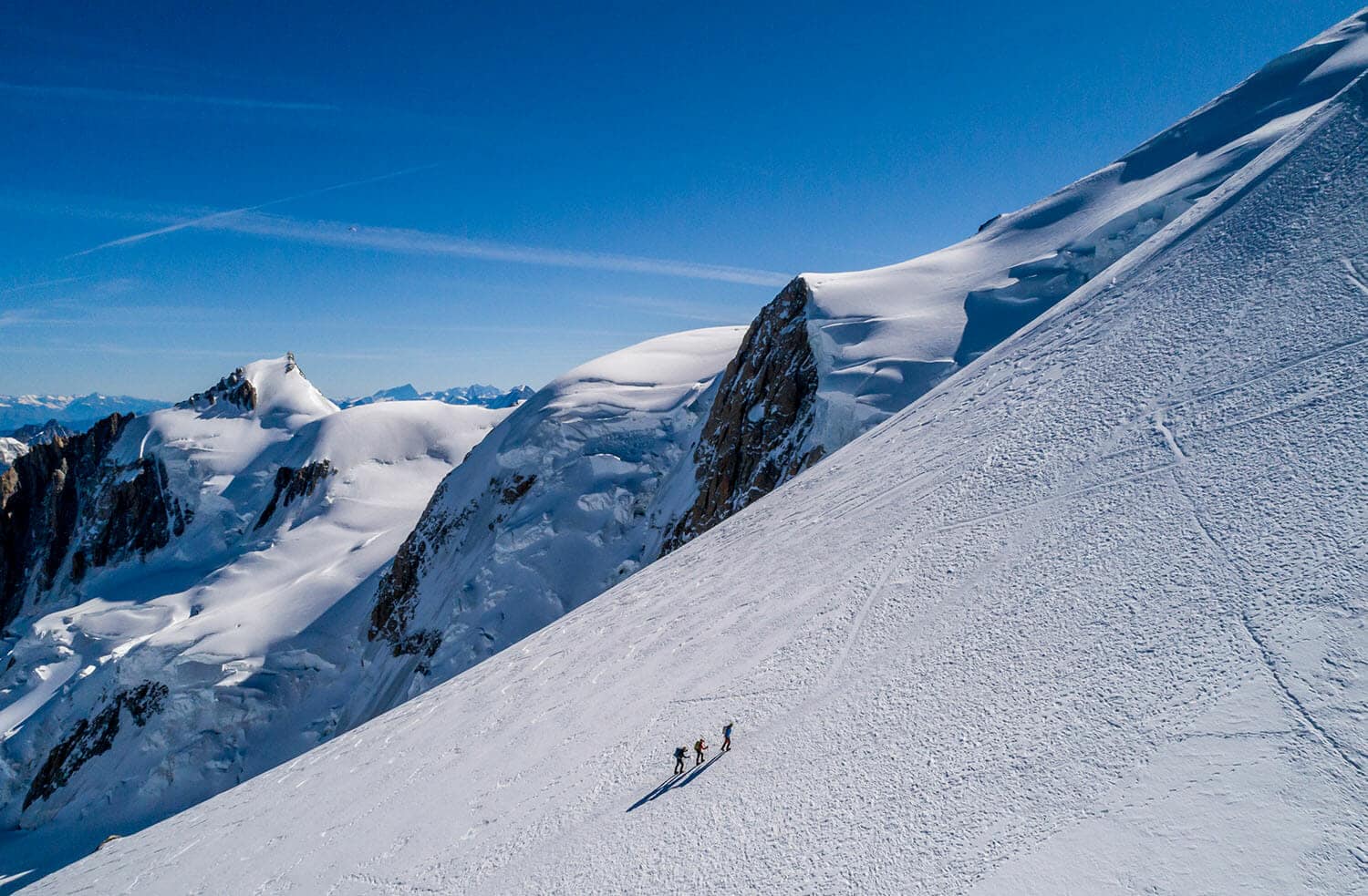
We previously flew our drones on Mont Blanc with Kiwi Aerial Shots for a video production documenting the incredible achievement of triathlete Andrea Masson. Our task was to capture her record-breaking feat in which she swam from England to France, cycled to Chamonix, and then conquered Mont Blanc on foot — all non-stop within five days. With Kiwi Aerial Shots we documented this unique achievement every step of the way, following her at sea, during the cycling leg, and ultimately positioning a second team at the summit of Mont Blanc to capture her arrival for the documentary Instilled. Watch the trailer below:
To the summit and back in 19 hours
To capture these drone shots in the mountains, our drone team had to acclimatize in the Alps three days before Andrea was due to reach the summit. Andrea herself lives in Chamonix and had already completed a significant amount of altitude training, and in the weeks leading up to her attempt, she also slept in an acclimatization tent to boost her red blood cell count. We did not have that luxury and headed straight into the mountains upon arriving from the Netherlands to train at altitude and allow our bodies to adjust to the lack of oxygen. During this acclimatization period, we also learned some basic alpine skills, including walking with crampons, moving roped together, and how to rescue each other from a potential crevasse. All of this with an Inspire 2 on our backs along with all the necessary batteries and controllers.
After several days of training, we prepared ourselves for the big push to the summit of Mont Blanc. The weather was fantastic, and we spent the night before the summit attempt at the Tête Rousse hut, as the Goûter hut was already fully booked. This meant we had to start from further away and faced a longer return journey as well. It also meant crossing the Goûter couloir twice on what was already an enormously long day. The couloir is a place where rocks fall constantly and where you have to sprint across during the brief moments when no rocks are coming down.
We set off at 4am on the third day, roped together as a group of three, ready for a very long climb. Everything went perfectly, and we eventually reached the summit well ahead of Andrea’s arrival and in fantastic conditions, great for us and great for the batteries, which stayed at a good temperature for the drone shots. Two wonderful hours followed in which we took in the views and prepared ourselves before Andrea arrived, and we were able to capture all the footage we needed. There was nobody else on the summit, so everything was truly perfect. Satisfied and with beautiful shots in the bag, we made our way back down to the hut, though all in all we had walked for 16 hours, spent 3 hours on the summit, and after 19 grueling hours we were completely done for.