DUTCH DRONE REGULATIONS
All About Dutch Drone Regulations
INTRODUCTION
When Kiwi Aerial Shots started flying in 2012, the word “drone” did not even exist in aviation regulations. There were no certificates, no categories, no no-fly zone maps and no mandatory insurance. You bought a multirotor, flew it, and hoped nobody complained. A lot has changed since then.
Today, Dutch drone regulations are part of a broad European framework established by EASA, the European Union Aviation Safety Agency. In the Netherlands, IL&T, the Inspectie Leefomgeving en Transport (Inspectorate for the Living Environment and Transport), is the supervisory authority responsible for enforcing the rules on behalf of the Ministry of Infrastructure and Water Management. To stay up to date with the latest changes, keep an eye on the websites of IL&T and DroneWatch. DroneWatch is the independent news platform for drone pilots in the Netherlands and publishes weekly updates on legislation and regulations.
This page gives a complete overview of Dutch drone regulations: from the basic rules for recreational pilots to the EASA Specific Category certification we hold as a professional drone company. We cover the categories, the steps to obtaining your drone licence, the specific rules for FPV drones, CTR zones and all no-fly zones every drone pilot in the Netherlands needs to know.
CONTACT US FOR A PROFESSIONAL DUTCH DRONE TEAM!

THE THREE CATEGORIES: OPEN, SPECIFIC AND CERTIFIED
Since 2022, European drone regulations have been fully in force in the Netherlands. The old distinction between commercial and recreational use no longer applies. Instead, everything revolves around risk: how heavy is the drone, where are you flying, how high, and near whom? Based on that, you fall into one of three categories.
The Open category is for drones with a low risk profile. These are mostly the lighter consumer drones flown by recreational pilots and small businesses. You need a theory exam, but no government approval per flight.
The Specific category is for flights with a higher risk: heavy drones, flights in urban areas, flights close to people, above 120 metres or beyond the pilot’s line of sight. Professional drone companies like Kiwi Aerial Shots operate in this category. You need an approved operational manual and a valid operator licence from IL&T.
The Certified category is reserved for the future of autonomous drone flights: parcel delivery, drone taxis and other fully automated operations. For most drone pilots and companies, this is not yet relevant.

OPEN CATEGORY: A1, A2 AND A3
The Open category is divided into three subcategories. Which one applies depends on the weight of your drone and its C-label classification.
Subcategory A1 is for drones up to 250 grams without a C-label, and for C1-drones up to 900 grams. You may fly near people, but not over crowds. Registration as an operator is mandatory as soon as your drone has a camera or weighs more than 250 grams. You need the online A1/A3 theory exam.
Subcategory A2 is for C2-drones from 900 grams up to 4 kilograms. The minimum horizontal distance to people and uninvolved persons is 30 metres, or 5 metres in slow-speed mode. You need both the A1/A3 exam and the additional A2 certificate.
Subcategory A3 is for C3 and C4-drones up to 25 kilograms. You must fly at least 150 metres from residential, commercial, recreational and industrial areas. Only the A1/A3 theory exam is required.
Basic rules that apply to all flights in the Open category: you are at least 16 years old, you fly no higher than 120 metres, your drone remains within direct line of sight at all times (VLOS), you only fly during daytime, you have liability insurance that explicitly covers drone incidents, and you always check GoDrone.nl in advance to confirm your location is cleared for flight.
NO-FLY ZONES NETHERLANDS
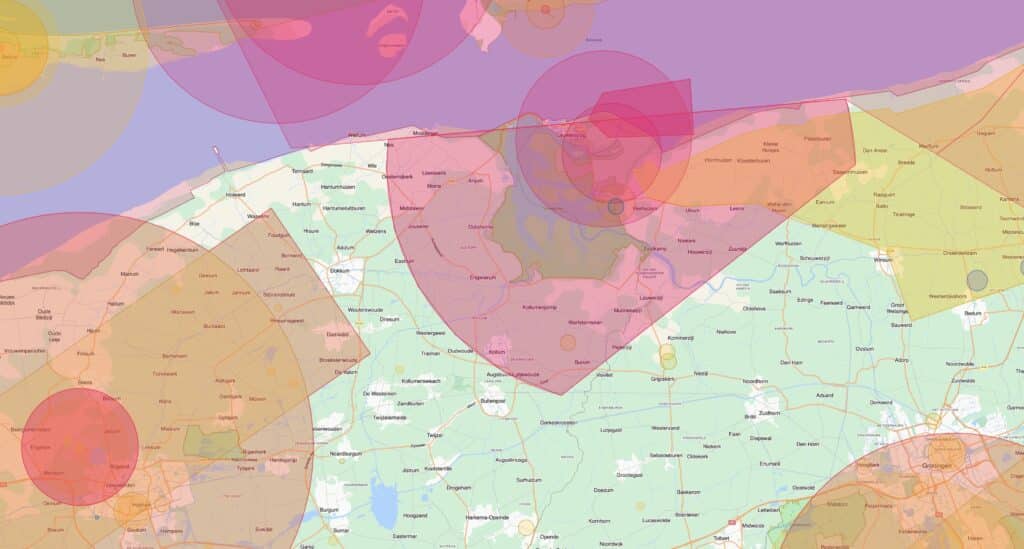
RESTRICTED AIRSPACE AND NO-FLY ZONES
A CTR zone is the controlled airspace surrounding an airport. Until recently, the basic rule was simple: no drone in a CTR without explicit permission from air traffic control. Check the GoDrone map for these zones.
Natura 2000 areas are European protected nature reserves. Flying here is in principle prohibited without an exemption from the competent authority. They are marked in green on the GoDrone map, or on this Natura 2000 map.
Urban areas and continuous built-up environments: in the Open category, flying here is not permitted or severely restricted. In the Specific category it is possible with the right certification and mitigating measures.
Critical infrastructure: power plants, water treatment facilities, Schiphol and other key installations have an extensive buffer zone around them where flying is strictly regulated or prohibited.
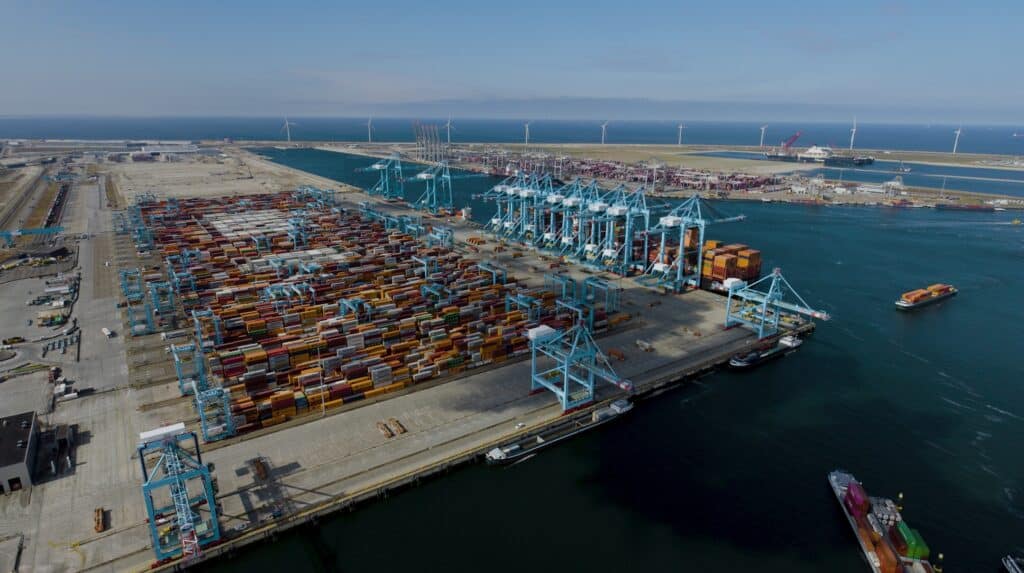
The Maasvlakte and Rotterdam port area fall partly under the CTR of Rotterdam The Hague Airport and partly under specific area designations by the Port of Rotterdam Authority. For productions on the Maasvlakte, we always coordinate in advance with the Port Authority, which nowadays goes through the Airwayz app.
Helipads each have their own protected zone visible on the GoDrone map. Hospitals with a rooftop landing pad are included in this.
Privacy and filming people: a drone with a camera falls under the GDPR, the General Data Protection Regulation. You may not simply film people without their consent, particularly when footage can be traced back to individual persons. This applies to aerial footage as well. Some leeway exists in public spaces, but targeted filming of people in their private surroundings is not permitted. For commercial productions, we always recommend seeking legal advice in advance regarding the use of the footage.
Infrastructure and transport corridors: specific distance rules apply near motorways, railway lines and busy waterways. In the Open category, flying above or directly alongside national roads and rail infrastructure is not permitted without prior permission. Exact distances and exceptions are shown on the GoDrone map per location. For professional productions where a drone flies over or alongside a motorway or railway, a Specific category operation is always required with approval from Rijkswaterstaat or ProRail.
Night flights are not permitted in the Open category. In the Specific category, night flying is possible with proper night certification and the appropriate mitigating measures. Kiwi Aerial Shots is night-certified and operates its own drone lighting systems for professional night productions.
Flying outside UDP, outside the Unilateral Declared Procedure, is a term relevant to operations in controlled airspace. This always requires coordination with air traffic control, regardless of category.
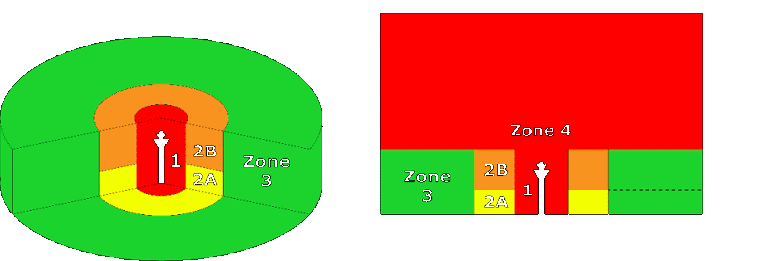
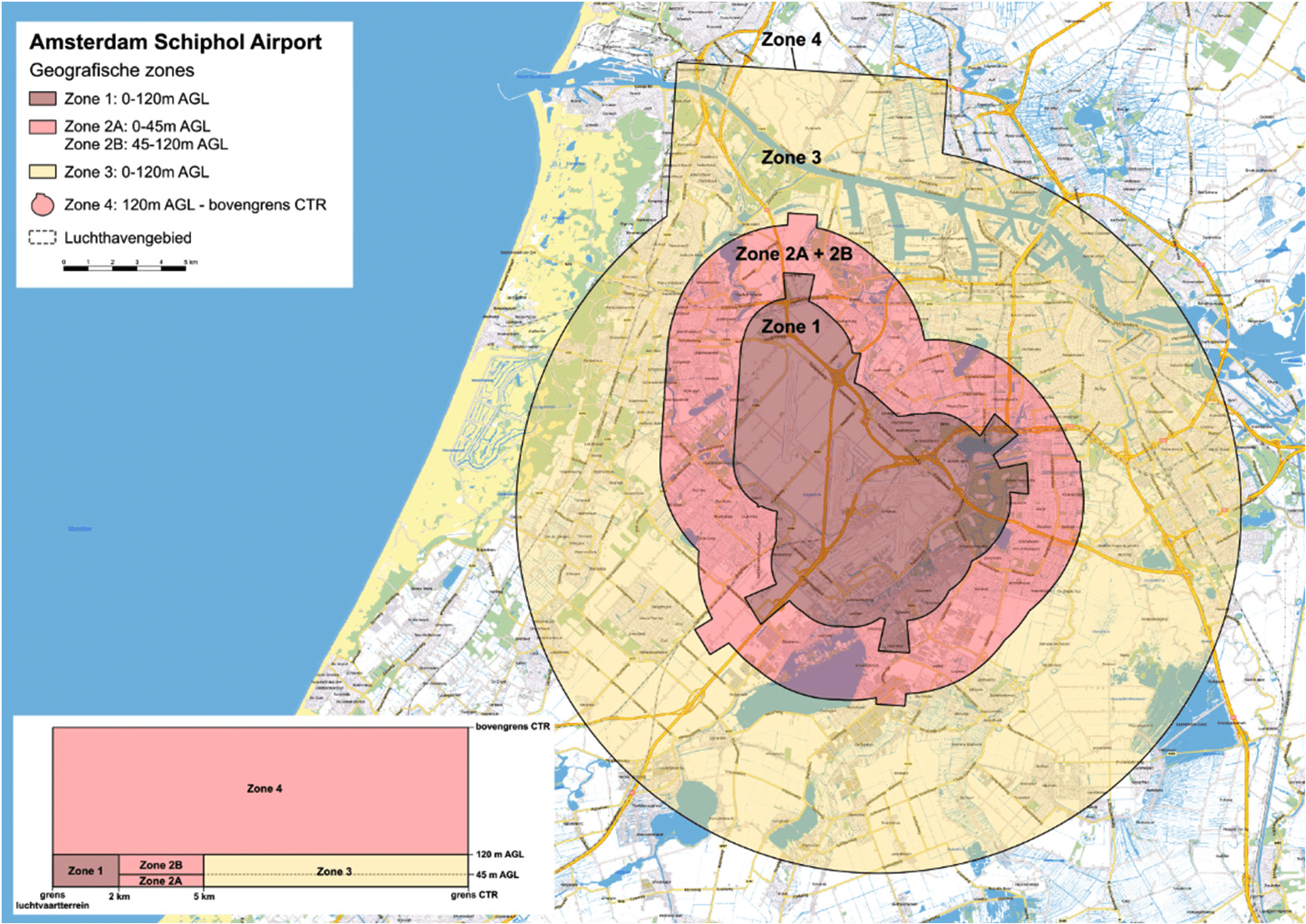
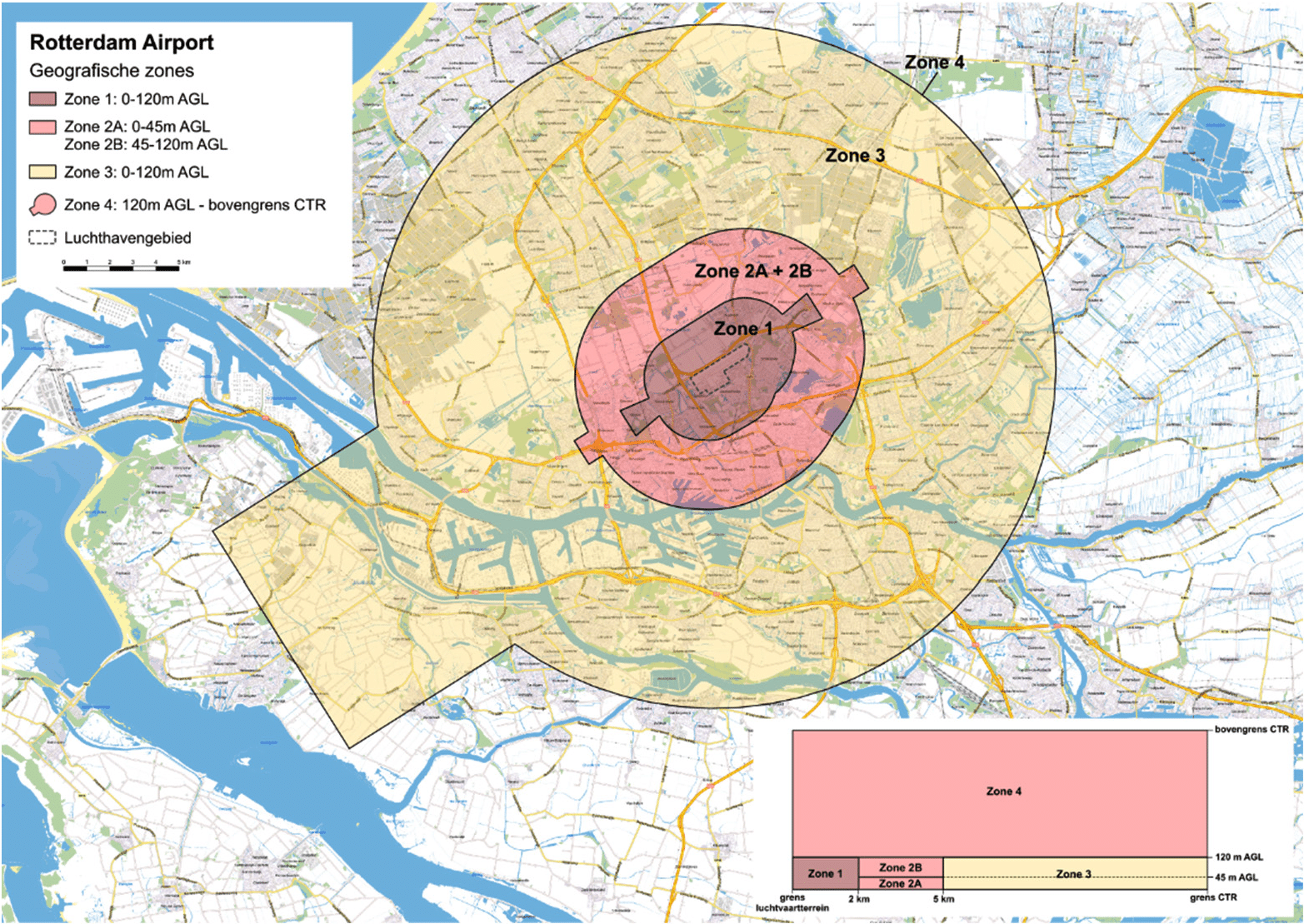
CTR ZONES AND THE NEW REGULATIONS FROM NOVEMBER 2026
Maastricht-Aachen and Lelystad, parts of the CTR are being opened up for drone flights without prior permission. The new system works with zones:
Zone 1: no change, existing restrictions remain in force.
Zone 2a: drone pilots in the Specific category may fly here without permission from air traffic control, provided all other conditions are met.
Zone 3: both Open and Specific category pilots may fly here without permission. This is the zone with the most new freedom, particularly for recreational pilots.
Zones 2b and 4: an exception applies exclusively to Specific category operators: flying within 30 metres of buildings or obstacles is permitted without prior permission.
Military airports are not affected by this change and remain under existing restrictions. The exact zone boundaries will be published on GoDrone and Aeret. Always check those maps before your flight, even if you assumed a location was clear.
For professional productions in Amsterdam or Rotterdam, we have been operating as a Specific category operator for years with an RT-operator and a 10-metre antenna mast for radio contact with air traffic control. That approach remains in place for Zone 1 and complex operations, also after November 2026.
DUTCH FPV DRONE REGULATIONS
FPV drones, First Person View drones, form a separate category within the regulations. The pilot flies via goggles or a monitor and has no direct line of sight to the drone: this is technically BVLOS, flying beyond the direct visual field. That places FPV flights outside the Open category by default.
In addition to the basic drone rules that apply to every drone, the following rules also come into play:
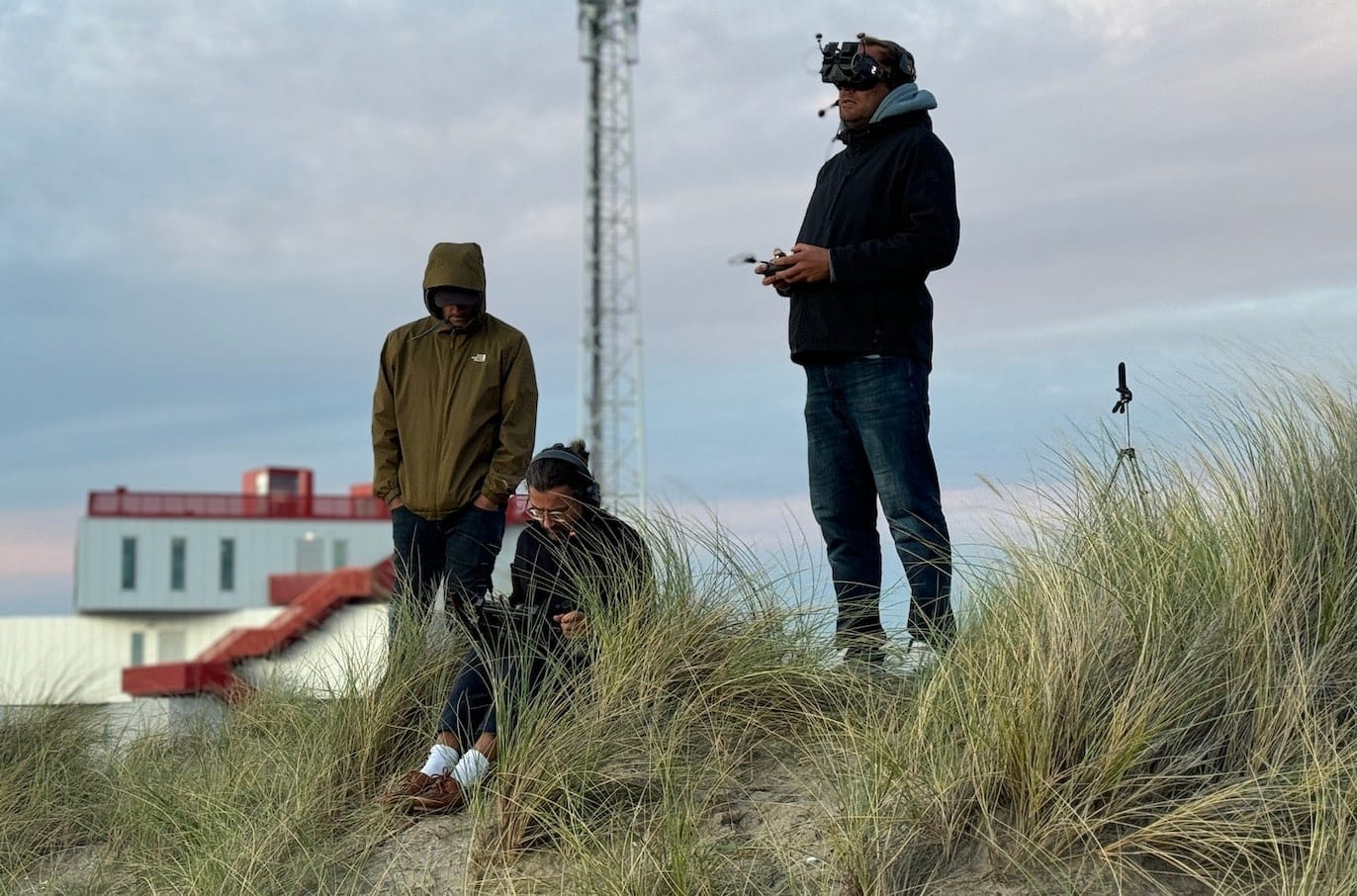
For recreational FPV flying, a buddy system is mandatory: a second person, the spotter, keeps the drone in direct line of sight at all times and can intervene or alert the pilot. With a spotter, the flight still falls within VLOS and therefore within the Open category, provided all other conditions are met.
For professional FPV productions, where drones fly at speed through urban environments, past actors or in industrial settings, we always operate in the Specific category. A spotter is present on every FPV shoot, supplemented by the mitigating measures from our approved operational manual.
BVLOS, Beyond Visual Line of Sight, refers to flying where the drone travels beyond the combined direct visual field of both pilot and spotter. This always requires a Specific category operation with explicit approval from IL&T per operation or operation type.
HOW TO GET YOUR DUTCH DRONE LICENCE
Is your drone heavier than 250 grams or does it have a camera? These are the steps:
Step 1: Register yourself as an operator with the RDW. This is a one-time fee and gives you an Operator ID.
Step 2: Attach your Operator ID to your drone, for example as a sticker.
Step 3: Pass your theory exam. For A1/A3 flights, the free online exam via the RDW website is sufficient. For A2 flights, you additionally need the paid A2 certificate from an accredited provider such as Drone Flight Academy or Dutch Drone Academy.
Step 4: Sort your insurance. Check whether your liability insurance explicitly covers drone incidents. Many standard policies exclude this.
Step 5: Install the GoDrone app. This shows you in real time which areas are open, lets you check NOTAM information and allows you to register your flights as a professional operator.

REMOTE ID AND C-LABELS
Since 1 January 2024, C-labels are mandatory on new drones. The label (C0 through C4) determines which subcategory you are permitted to fly in. Home-built drones under 250 grams do not yet require a label.
Also mandatory since 2024 is Remote ID: your drone automatically broadcasts your operator number so that enforcement officers, police and other airspace users can identify who is flying. This applies to C1, C2 and C3 drones. If your drone does not have built-in Remote ID, there are external transmitters available on the market, known as drone tags, which you attach to your drone. You can purchase these at Droneland, see this drone tag page.

THE SPECIFIC CATEGORY: FOR PROFESSIONAL DRONE COMPANIES
Flights that fall outside the Open category fall within the Specific category. Examples: flying in urban areas, closer than the legal distance to people, above 120 metres, with drones over 25 kilograms or beyond the pilot’s line of sight (BVLOS). This is the category in which Kiwi Aerial Shots operates as a certified drone company, holding an EASA Specific Category operations licence under number NLD-OAT-026.
Within the Specific category there are three routes for operational approval:
STS, the Standard Scenarios. The flight falls entirely within a standard scenario predefined by the ministry. The company does not need to submit a separate risk assessment per flight, but does require a one-time approval from IL&T for its operational manual.
PDRA, the Pre-Defined Risk Assessment. The company draws up a risk assessment per flight type, which is approved by IL&T. The assessment works with two axes: the GRC (Ground Risk Class) for risks on the ground, and the ARC (Air Risk Class) for risks in the airspace. The flight may only be carried out after approval.
SORA, the Specific Operation Risk Assessment. The most comprehensive route, intended for complex operations. The company describes equipment, mitigating measures and works out the SAIL: the Specific Assurance and Integrity Levels (I through VI). Based on the SAIL level, the OSOs are established: the Operational Safety Objectives that cover risks relating to the pilot, the aircraft and the organisation.
ALTMOC AND ENHANCED CONTAINMENT
For operations in urban areas or close to people, Specific category companies often work with an AltMoC: an Alternative Means of Compliance. These are specifically approved mitigating measures that demonstrate a flight can be carried out safely, even when standard safety requirements cannot be met in the conventional way. A widely used AltMoC is Enhanced Containment: a combination of technical and procedural measures that drastically reduce the likelihood of an uncontrolled emergency landing outside the flight area. Think geofencing, redundant systems and trained spotters.
For productions in Amsterdam or Rotterdam where we fly close to actors or the public, our approved AltMoC is the foundation on which IL&T grants permission for the flight.
PROFESSIONAL PREPARATION: FLIGHT PLAN AND MITIGATING MEASURES
A Specific category flight starts in the office, not on location. Our approved operational manual requires a flight plan for every production. This sets out the flight zone, maximum flight altitude, the number of people within the flight area, communication lines with air traffic control and the procedures in the event of an emergency landing or technical failure.
On location, we work with a fixed checklist: from the pre-flight inspection of the drone and batteries to weather conditions, wind speed and visibility. That checklist is not a formality, but a requirement from our manual and part of our EASA certification.
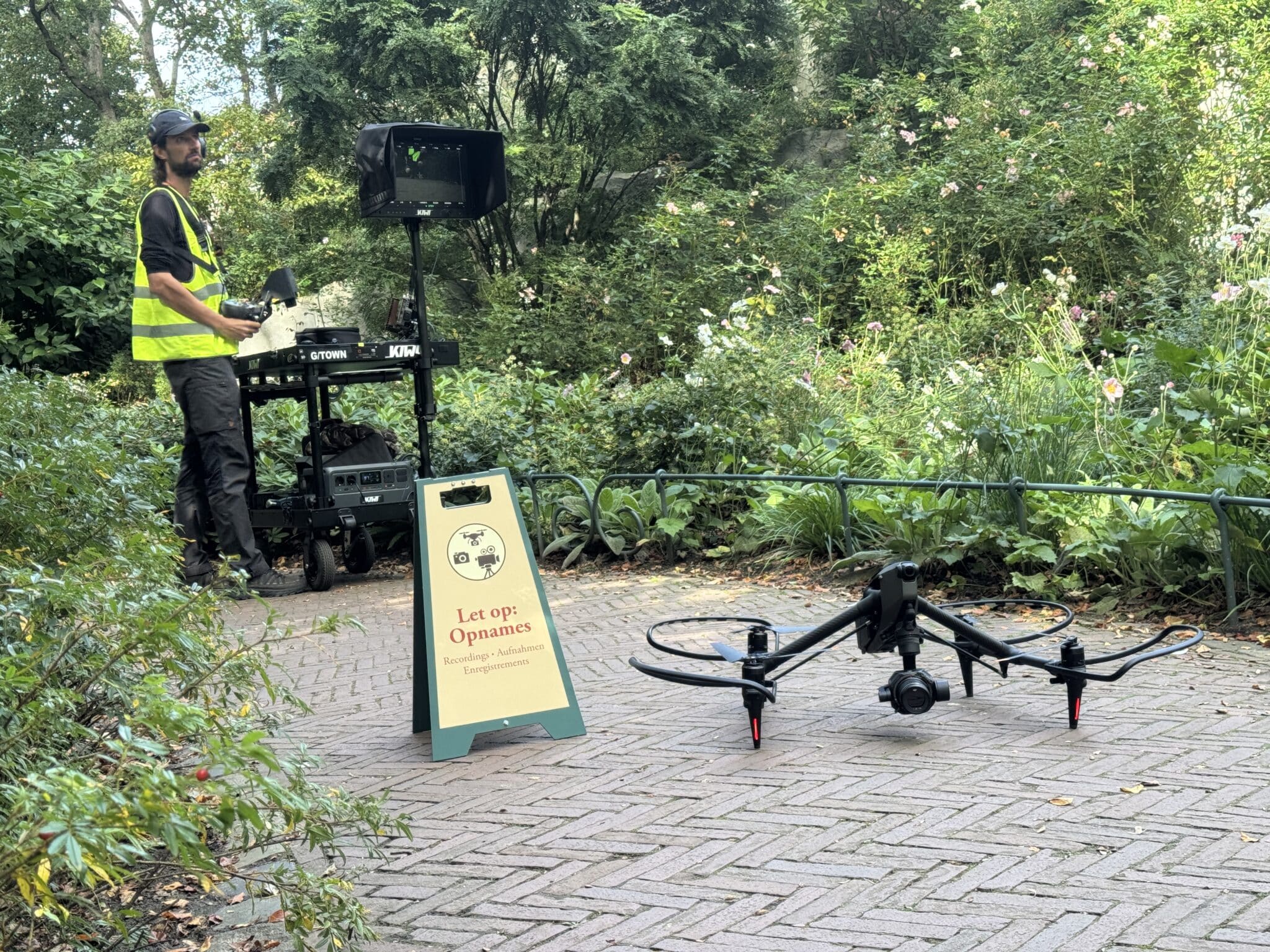
Mitigating measures are the physical and procedural measures that limit the risk to people on the ground. In practice, for professional productions this means: cones and barrier tape clearly marking the flight zone, high-visibility vests for ground crew actively involved in the flight, and a fire extinguisher that is standard equipment at every flight location.
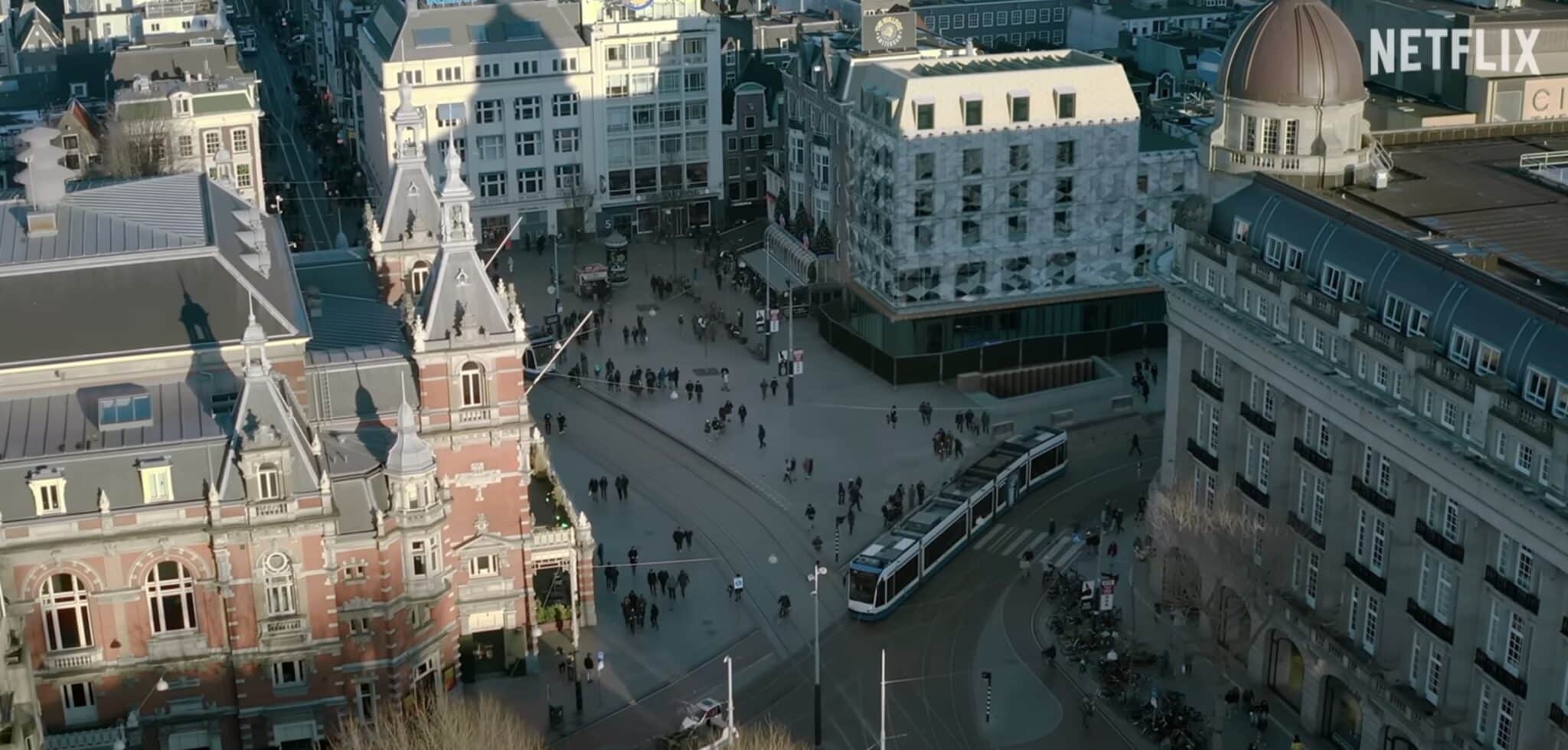
For larger productions in public spaces, think of a TVC on Dam Square or a feature film with street scenes in Rotterdam, we work together with the municipality and the production to secure the flight area. This can mean streets are temporarily closed off, bystanders are kept outside a defined radius by production staff, or additional spotters are positioned at the corners of the flight zone. All of these measures are part of the approved operational plan submitted to IL&T in advance, or fall within our existing AltMoC approval.
This preparation takes time and people, but it is also exactly what makes the difference between a professional production that runs safely and without incident, and a flight that puts crew, cast and public at risk.
DCRO: THE ORGANISATION BEHIND SPECIFIC CERTIFICATION
The DCRO, Drone Certified Remote Operators, is the Dutch industry association for Specific category drone companies. The DCRO supports companies in drawing up and maintaining their operational manuals and monitors the quality standard within the sector. As a certified Specific category company, Kiwi Aerial Shots is a member of the DCRO.
More information can be found on the DCRO website.
QUESTIONS AND CONTACT
For the most current regulations, always refer to the official sources: IL&T via ilent.nl and DroneWatch via dronewatch.nl. No rights can be derived from the information on this page; regulations change regularly.
Are you looking for a certified drone company for a professional production in the Netherlands or abroad? Get in touch via the form below or browse our services on the homepage.
Official information: IL&T drone page
DISCLAIMER
No rights can be derived from the information above. New laws and regulations may have been introduced that are not mentioned on this page.